Fifteenth Summer School on Formal Techniques
May 23-29, 2026
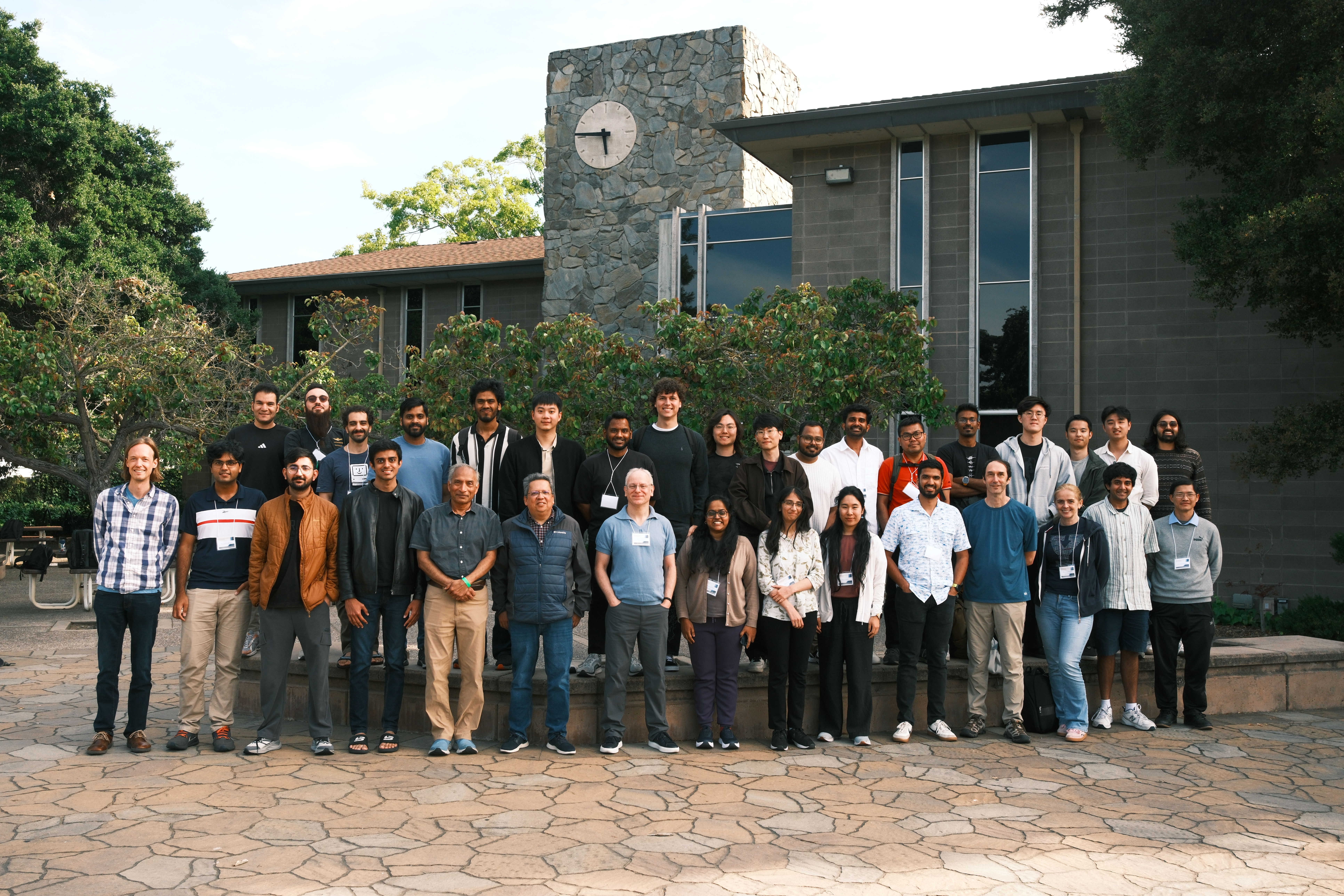
Overview
Techniques based on formal logic, such as model checking, satisfiability, static analysis, and automated theorem proving, are finding a broad range of applications in modeling, analysis, verification, and synthesis.
This school, the fifteenth in the series, focuses on the principles and practice of formal techniques, with a strong emphasis on the hands-on use and development of this technology. It primarily targets graduate students and young researchers who are interested in studying and using formal techniques in their research. A prior background in formal methods is helpful but not required.
Participants can expect to have a seriously fun time experimenting with the tools and techniques presented in the lectures during the laboratory sessions. The main lectures run from Monday, May 25 to Friday, May 29. They are preceded by a background course, Speaking Logic, on May 23 and 24.
Week-long lectures by:
- Aws Albarghouthi, Compilers for Quantum Computers
- Cas Cremers, Analyzing Cryptographic Protocols with Tamarin
- César Muñoz, Developing and Proving Algorithms with PVS
- Ruzica Piskac, Privacy-Preserving Reasoning
- Chris Hawblitzel, Verifying Rust code with Verus
Invited talks by:
- Mohsen Lesani, Verified Distributed System Generation
- Alvin Cheung, Towards Verified and AI-Driven Accelerator Programming
- Thomas Wies, Concurrent Separation Logic
See Zoom information for Zoom details.
Lectures
Compilers for Quantum Computers
Aws Albarghouthi, University of Wisconsin-Madison
Abstract. Quantum computers have the potential to transform drug discovery, materials design, energy production, and beyond. Recent breakthroughs in physical implementations have brought this technology closer to reality. In this course, we will learn about the problem of compiling quantum programs to run on quantum processors. Even though state-of-the-art quantum computers are still experimental and small in scale, the compilation problem is critical for understanding the resources required for running different applications on different emerging hardware and architectures. The course begins with a brief introduction to quantum computing fundamentals and then transitions to two key phases of quantum compilation: circuit optimization, and mapping and routing.
Bio. Aws Albarghouthi is an associate professor of computer science at the University of Wisconsin-Madison. He works in programming languages and formal methods, developing new techniques for automatically building reliable and secure software systems. He received his PhD from the University of Toronto in 2015. He has received paper awards at PLDI, FSE, UIST, and FAST, an NSF CAREER award, and multiple industry awards from Meta, Google, and Amazon. He also received the Class of 1955 Teaching Excellence Award, one of the University of Wisconsin’s highest teaching honors.
Materials and references.
Analyzing Cryptographic Protocols with Tamarin
Prof. Dr. Cas Cremers, CISPA Helmholtz Center for Information Security
Abstract. The Tamarin prover is a state-of-the-art tool for cryptographic protocol analysis. Protocols are specified using multiset rewriting, and a subset of first-order logic is used to specify protocol properties. Tamarin then supports automated analysis of protocols with respect to their specified properties. Tamarin has a large user community and has been successfully used to analyze numerous industry protocols and standards, leading either to the discovery of subtle attacks or to automated proofs.
Bio Prof. Dr. Cas Cremers is faculty member at the CISPA Helmholtz Center for Information Security in Saarbruecken, Germany.
He obtained his PhD in 2006 from Eindhoven University of Technology in the Netherlands. From 2006 to 2013 he was a postdoctoral researcher, and senior researcher and lecturer, at ETH Zurich in Switzerland. In 2013 he moved to the University of Oxford as an Associate Professor, and became full Professor at the University of Oxford in 2015. In 2018 he joined CISPA in Germany.
His work includes co-developing the Scyther tool and the Tamarin prover for the analysis of security protocols, and working on provable foundations for secure messaging, including the first proofs of the Signal protocol. He contributed to the development of IETF’s TLS 1.3 and MLS. He served as PC co-chair of ACM CCS 2022 and 2023. He was awarded the 2026 IACR Levchin Prize for Real-World Cryptography as part of the Tamarin team.
Materials. To prepare for the summer school, students are highly recommended to read the first two chapters of the Tamarin book. A PDF of the book can be freely downloaded on the Tamarin website: https://tamarin-prover.com/book/index.html. Of course, feel free to read more chapters.
Tamarin is open-source software; the manual, the Tamarin book, source code, and scientific papers are available at tamarin-prover.com. For examples of its real-world use, see this report.
Lab session/materials located @ https://github.com/cascremers/tamarin-tutorial-ssft2026.
Developing and Proving Algorithms with PVS
Dr. César Muñoz, NASA Langley Research Center
Abstract. These lectures provide a practical introduction to specifying, verifying, and validating algorithms using the Prototype Verification System (PVS), an interactive environment for system specification and verification. PVS features a strongly typed specification language based on higher-order logic, with a type system that supports predicate sub-types, dependent types, inductive data types, parametric types, prenex polymorphism, and built-in types and data structures such as numbers, booleans, strings, records, unions, tuples, arrays, sequences, sets, and lists.
The PVS theorem prover includes decision procedures for linear arithmetic, propositional logic, and temporal logic, and users can conservatively extend its deductive capabilities through custom proof strategies. NASALib is a comprehensive library of fundamental mathematics developed in PVS, along with utilities for proving and animating specifications. These lectures focus on the development and verification of algorithms through examples inspired by actual NASA verification projects. The lectures provide a gentle introduction to advanced PVS features, including induction-less induction, modeling with deep and shallow embeddings, and differential testing via model animation.
Bio. Dr. César Muñoz is a Research Computer Scientist at NASA, leading the Formal Methods Team at NASA Langley Research Center. He earned his PhD in Computer Science from the University of Paris 7, currently Paris Cite University, in France. Dr. Muñoz began his NASA career as a contractor in 1999 before transitioning to a civil servant role in 2009. Between 2021 and 2023, he served as Senior Principal Applied Scientist at Amazon Web Services, managing the S3 Automated Reasoning Team. He returned to NASA in 2023 to advance the development and application of formal methods for designing, analyzing, implementing, and verifying safety-critical systems relevant to NASA missions.
Dr. Muñoz is a recognized expert in SRI’s Prototype Verification System and has developed numerous strategies, libraries, and utilities for PVS, which are publicly available. His contributions to PVS include Interval Arithmetic, ACCoRD, PVSio, ProofLite, and Extrategies.
Materials. Click here for slides, exercises, etc.
More! Thirty Years of Formal Methods Research At NASA Langley - Ricky Butler (NFM 2018)
Privacy-Preserving Reasoning
Prof. Ruzica Piskac, Yale University
Abstract. Formal methods offer a vast collection of techniques to analyze and ensure the correctness of software and hardware systems against a given specification. Modern formal methods tools scale to industrial applications, but privacy requirements are not usually considered in their design. For example, automated reasoning tools often assume that the formula to be proved is public, which is a problem if the formula itself reveals information that should remain private to one party. To overcome this issue, we propose privacy-preserving automated reasoning.
In these lectures, students will learn how to incorporate cryptographic primitives into automated reasoning. We will present a privacy-preserving Boolean satisfiability solver that allows mutually distrustful parties to evaluate the conjunction of their input formulas while maintaining privacy. We will also show how to prove unsatisfiability of formulas using zero-knowledge protocols, and discuss how the full formal verification workflow can be applied in privacy-preserving settings.
Bio. Ruzica Piskac is a Professor of Computer Science at Yale University, where she leads the Rigorous Software Engineering (ROSE) group. Her research interests span software verification, security and applied cryptography, automated reasoning, and code synthesis. Much of her research has focused on using formal techniques to improve software reliability and trustworthiness. Piskac joined Yale’s Department of Computer Science in 2013. She was previously an Independent Research Group Leader at the Max Planck Institute for Software Systems in Germany.
Her research has received a range of professional honors, including multiple Amazon Research Awards, Yale University’s Ackerman Award for Teaching and Mentoring, the Facebook Communications and Networking Award, and the Microsoft Research Award for the Software Engineering Innovation Foundation. In 2019, Yale named Piskac the Donna L. Dubinsky Associate Professor of Computer Science. Piskac holds a PhD from the Swiss Federal Institute of Technology, EPFL, where her dissertation won the Patrick Denantes Prize. Her current and recent professional activities include service as Program Chair of the 37th International Conference on Computer Aided Verification and on the Steering Committee of the Formal Methods in Computer-Aided Design conference. Piskac has graduated six PhD students, four of whom are now faculty members.
Materials. The lectures will mainly be based on the following papers:
- ZKSMT: A VM for Proving SMT Theorems in Zero Knowledge
- Ou: Automating the Parallelization of Zero-Knowledge Protocols
- Proving UNSAT in Zero Knowledge
- ppSAT: Towards Two-Party Private SAT Solving
Lecture slides.
Lab materials. See here!
Verifying Rust Code with Verus
Dr. Chris Hawblitzel, Microsoft Research
Abstract. The Rust programming language is rapidly gaining acceptance as a modern, type-safe alternative to C and C++ for low-level systems programming. Rust includes an advanced type system, similar to languages like Haskell and ML, that makes formal reasoning more elegant and natural. Most importantly, Rust implements a novel ownership checker that manages aliasing and mutation, allowing safe manual deallocation of unaliased values and prohibiting mutation of aliased values. This ownership methodology is ideal for formal verification: it allows a verifier to reason about values rather than mutable heap locations, making verification of Rust code similar to verification of purely functional high-level languages.
This course introduces Verus, a verifier for Rust code. With Verus, programmers express proofs and specifications using Rust, allowing proofs to take advantage of Rust’s type checking and ownership checking. The course describes how to write such specifications and proofs, and how the Verus tool translates them into formulas that can be efficiently checked by an SMT solver. It also describes how to write proofs that take advantage of Rust’s ownership to express separation and permissions in a style similar to separation logic, and how to use this style to verify safe Rust code, unsafe Rust code, and concurrent Rust code.
The course includes both lectures and hands-on exercises. Students can install Verus on any Linux, MacOS, or Windows laptop to edit and verify Rust code during the course. No knowledge of Rust is required beforehand.
Bio. Chris Hawblitzel is a Senior Principal Researcher at Microsoft Research in Redmond, WA. His research focuses on using programming language techniques and formal verification to enforce the safety and security of systems software. He has worked on projects including the Singularity OS, the Verve verified OS, the Ironclad/IronFleet verified software stack, the Everest verified TLS project, and the Verus verifier for Rust.
He has co-authored papers receiving best paper awards for Verve at PLDI and Verus at OSDI, a CACM research highlight for IronFleet, distinguished paper awards for Vale at USENIX Security and Linear Dafny at OOPSLA, and distinguished artifact awards for Verus-related projects at SOSP, OSDI, and OOPSLA. He received a BA in physics from UC Berkeley in 1993, received a PhD in computer science from Cornell in 2000, taught at Dartmouth College until 2004, and has been a researcher at Microsoft Research since 2005.
Materials. Located here!
Invited Speakers
Verified Distributed System Generation
Prof. Mohsen Lesani, UC Santa Cruz
Abstract Distributed systems underpin modern computing. Yet, building distributed systems and interfaces with strong reliability and security guarantees remains elusive. This talk presents our cross-stack research on the automatic generation and verification of distributed systems. I will describe two projects: Hamsaz and Hamraz. Given a class of data objects such as a relational schema annotated with integrity and recency requirements, Hamsaz automatically generates a correct-by-construction replicated class that guarantees integrity, convergence and recency, while minimizing coordination overhead. Given an online service as a class of objects and its end-to-end confidentiality, integrity and availability policies, Hamraz applies information flow type inference to automatically partition, place and replicate the fields and methods of the class across quorum systems, and synthesize trustworthy-by-construction distributed systems. Finally, I will close with an overview of our ongoing work on LLM-assisted generation of verified distributed systems.
Bio. Mohsen Lesani is an Associate Professor in the Department of Computer Science and Engineering at the University of California, Santa Cruz, currently on sabbatical at UC Berkeley. He was a postdoctoral researcher at MIT and received his PhD from UCLA. His research spans formal methods and distributed systems. He received the NSF CAREER Award in 2020 and the DARPA YFA in 2022. His research has been recognized as a SIGPLAN Research Highlight and received a distinguished paper award at OOPSLA.
Towards Verified and AI-Driven Accelerator Programming
Prof. Alvin Cheung & Sahil Bhatia, UC Berkeley
Abstract Programming and optimizing hardware accelerators is notoriously difficult, requiring deep knowledge of both hardware and domain-specific languages (DSLs). Recent advances in AI, in particular large language models (LLMs), offer a new paradigm: leveraging pretrained models for verified code translation and hardware-aware optimization. In this talk, we will introduce LLMLift and Autocomp, two complementary frameworks that automate accelerator programming through LLM-driven compilation and verification, along with hands-on exercises for the audience to try out our tools.
Bio Alvin Cheung is a professor in the EECS department at UC Berkeley, where his group works on data management and programming systems research. Work from his group has received a number of best paper / poster / demo awards in different venues. Alvin is a PECASE awardee, a Sloan fellow, and a recipient of early career research awards from the data management research community, the programming languages research community, and various government agencies and companies.
Sahil Bhatia is a PhD student in EECS at UC Berkeley, advised by Alvin Cheung and Sanjit A. Seshia. His research focuses on verified code generation, with a particular interest in formally verified translation of programs into domain-specific languages (DSLs). He has previously worked on code generation and program synthesis problems at Google X and Microsoft Research.
Materials Slides
Concurrent Separation Logic
Prof. Thomas Wies, New York University
Abstract: Verifying concurrent programs remains a key challenge in formal verification. Modern concurrent separation logics provide an extensive toolbox of deductive reasoning techniques that help to tackle this challenge. In this talk, I will provide a tutorial explaining the high-level reasoning principles behind these logics and present Raven, a deductive verification tool that helps to automate this reasoning.
Bio: Thomas Wies is a Professor of Computer Science at the Courant Institute of New York University and Chair of the NYU Department of Computer Science. He is a recipient of an NSF CAREER Award and multiple best paper awards. His research interests are broadly in Programming Languages and Formal Methods.
Materials.: Slides + code from Raven live-coding
Student Presentations
We will have two sessions for the summer school students to present, demo, and share anything of interest in an open forum.
The topics can range from past research presentations, tool demonstrations/walkthroughs, or even watercooler conversations you’ve had over the week.
This is highly informal and can be as interactive as you, the presenter, see fit.
We can accommodate 5-minute (short) and 10-minute (long) presentations.
Sean Wang - Evaluating LLM-Translated Network Configurations
Sai Lalith Kumar Aka - On Compactness of Hoare Logic
- Abstract: We introduce compactness in logics and Hoare logic. We then present a short proof of why Hoare logic is not compact.
Tennov Simanjuntak - Zimpaf and RedPhuzz: High-Fidelity Web Application Fuzzing via Branch, Language Construct, and Function Call Monitoring
Youwei Zhong - Certified but Private: Scalable Zero-Knowledge Proofs for Neural Network Guarantees
- Abstract: With the increasing deployment of machine learning models, formal guarantees of the robustness and fairness of these models have become increasingly important in safety-critical and legal-compliance settings. However, model parameters are often commercial secrets that cannot be disclosed to auditors or end users. To this end, we present PANDA, a scalable system that uses Zero-Knowledge Proofs (ZKPs) to prove the robustness and fairness properties of a model without revealing its private parameters. PANDA is built on top of CROWN, an efficient robustness certification framework that is used in many state-of-the-art formal verification tools for neural networks. The core contribution of PANDA is a novel algorithm for proving linear relaxation bounds for non-linear activation layers, yielding simple, lightweight proofs. Remarkably, our system can generate proofs of local robustness for neural networks with more than 2.9M parameters in 5 minutes, and can verify them in 10 seconds. Prior ZKP-based robustness systems are based on exponential-time algorithms that cannot scale to nontrivial networks. In contrast, PANDA scales polynomially in the number of neurons in a network, allowing us to support neural networks 4 orders of magnitude larger than previous approaches with significantly reduced prover overhead.
Amar Shah - WIP: An SMT Solver for Program Verification
- Abstract: Program verification tools such as Dafny, Verus, and F* are commonly used to verify large-scale systems in industry and academia. These tools translate verification conditions into first-order logic and then call a Satisfiability Modulo Theories (SMT) solver in the back-end. While program verification has become more widespread, these tools are limited by a reliance on general-purpose SMT solvers. Specifically, these solvers struggle with unpredictable performance, correctness bugs, outdated components, and unmaintainable proofs. In the first half of this talk, I will describe some of the difficulties in program verification and some of the limitations of current SMT solvers. In the second half of the talk, I will discuss our approaches to fix these problems, building a new SMT solver from scratch.
Serra Dane - Towards Formal Verification of Hybrid Synchronous Programs
- Abstract: Cyber-physical systems (CPS) such as autonomous cars, aircraft, and robots are often also safety-critical; thus it is imperative that they operate as intended with a high degree of certainty. Formal verification has been employed to verify the software controlling these systems, but due to their complexity, is usually performed on an abstract model rather than the executable code. Synchronous programming languages extended with differential equations promise both rigorous modeling and sufficient expressiveness to implement executable controller code, and recent developments have introduced formal verification of strictly discrete-time programs. Extending these verification techniques to hybrid systems enables precise modeling of the environment for a wider variety of programs to be both verified and executed. We formalize the operational semantics of initial value problems and zero-crossing detection expressed in a synchronous programming language, extend its type system for verification thereof, and prove its soundness.
Speaking Logic
Natarajan Shankar and Stéphane Graham-Lengrand, SRI CSL
Formal logic has become the lingua franca of computing. It is used for specifying digital systems, annotating programs with assertions, defining the semantics of programming languages, and proving or refuting claims about software or hardware systems. Familiarity with the language and methods of logic is a foundation for research into formal aspects of computing. This course covers the basics of logic, focusing on the use of logic as a medium for formalization and proof.
Other Resources
More Exercises
See Problems for some challenging exercises. This will be updated over the course of the week.
Installing PVS/VSCode-PVS, Yices2, and SAL
PVS
New VSCode-PVS (updated for PVS 8.1)
To build from source (MacOS Apple Silicon/x86, Ubuntu aarch64/x86), clone the repository from GitHub and type ./configure && make.
You can try binary releases (for the above platforms) located at Github Releases.
Yices2 SMT Solver
For the full summer school experience, you will want the MCSAT (non-linear) solver. At the moment, this will require building from source. Clone the repository from GitHub, make sure you have the prerequisites (SRI-CSL/libpoly, cuddorg/cudd, and possibly others), and run ./configure --enable-mcsat with the path configured appropriately. Then, perform a make and make install.
On a successful build, you should have a yices2/build/<system>/ folder fully populated (with bin/, lib/, etc.).
We also offer brew and apt packages for Yices2, but they don’t come with the MCSAT solver enabled and will not be able to solve nonlinear queries. If you choose to go this route, please use brew install yices2 or apt-get install yices2.
SAL
SAL can be built from source, located on GitHub.
It requires Bigloo Scheme (4.6a+), which can be built via Homebrew, along with CUDD and Yices2.
In your ~/.salrc, include the following line: (sal/set-yices2-command! "<path-to-yices>/yices2/build/<system>/bin/yices")
Please do not install SAL from any other source, and please do not use an older Bigloo.
Previous Summer Schools
Updates & Quick Links
- May 29: Thirty Years of Formal Methods Research At NASA Langley - Ricky Butler (NFM 2018)
- May 29: Slides + code from Raven live-coding for Concurrent Separation Logic posted!
- May 28: Lecture 2 slides/Lab Materials for Privacy-Preserving Reasoning posted!
- May 28: Lecture videos 5/27 posted!
- May 27: Discord server/invite
- May 27: Lecture videos posted!
- May 27: Student Presentations, ~30 minutes on Wednesday (5/27) and longer on Friday (5/29): sign up
- May 26: More SMT background resources posted @ Other Resources!
- May 26: Lab Materials for Verifying Rust Code with Verus
- May 26: Lab Materials for Developing and Proving Algorithms with PVS
- May 26: Lecture 1 slides/background readings for Privacy-Preserving Reasoning posted!
- May 25: Lab Materials for Foundations of Quantum Computing
- May 25: Lab Materials for Analyzing Cryptographic Protocols with Tamarin
- May 24: Alvin Cheung’s slides available!
- May 24: Challenge/Bootcamp problems
- May 24: Installing PVS/VSCode-PVS, Yices2, and SAL - please do not find install instructions from old websites. We’re having trouble accessing our web portals and could not update them to reflect the state of the latest release. Sorry!
- May 23: Start of SSFT26! See schedule and Zoom information. In-person lectures held in Brawner Hall @ Menlo College (No. 12 on the Menlo College Map)
Registration
Registration is available here:
The 2026 Summer School on Formal Techniques will take place in a hybrid mode: the lectures and labs will be live-streamed and recorded. We strongly encourage in-person participation so that you can benefit from interactions outside the classroom. We have funding from NSF to cover transportation, food, and lodging expenses for selected US-based students. Non-student and non-US in-person participants are expected to cover their own transportation and will be charged a fee, around $150/day, to cover the cost of food and lodging.